


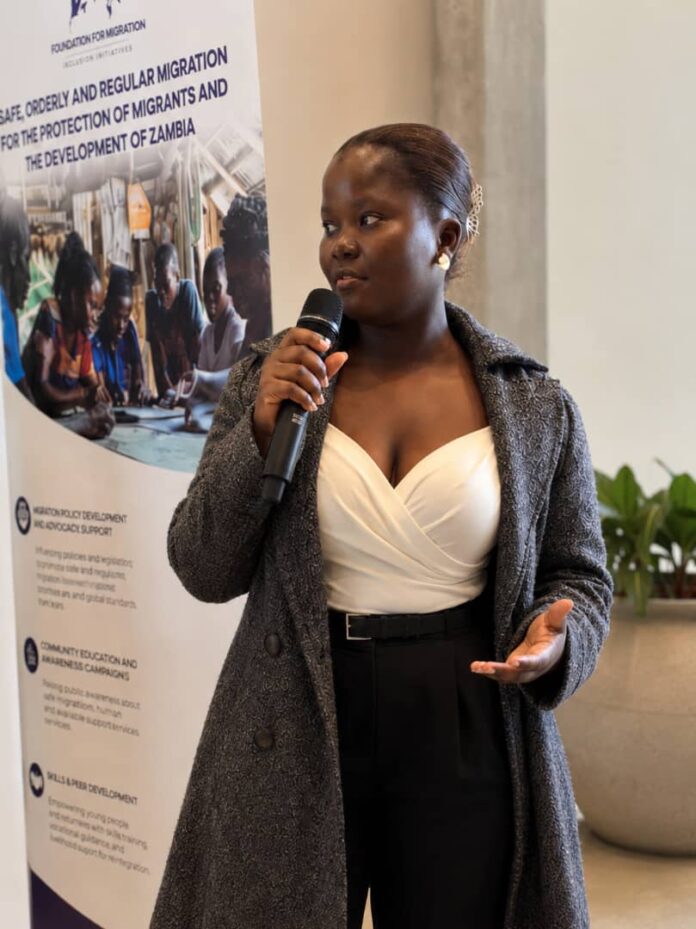
Growing up with uncertainty about identity, status, and future opportunities creates challenges that many people do not see.
For decades, Zambia has been a safe haven for people fleeing conflict, persecution, and instability in neighbouring countries.
While life offers them no choice other than fleeing war and conflict, for many people their lives and dreams seem shattered.
With only safety in mind many tend not to pay attention to what they had planned growing up.
While their journeys began with displacement, many refugees are now writing a new chapter defined by resilience, determination, and community integration.
Rwanda born refugee descendant, Uwera Chance Nj, who was born and raised in Zambia, says home is more than a geographical location.
“Home, to me is more than a place on a map. It is the place where I was born, where I took my first steps, where I went to school, built friendships, and learned the values that shape who I am today,” she said.
Uwera believes that Zambia is where she belong and that its culture has influenced her upbringing.
However, the reality is often far more complicated than any emotional attachment.
While Zambia is the only home Uwera has ever truly known, there are moments when legal and social realities make her feel as though her belonging is questioned.
”I grew up here, speak the languages spoken here, and share the experiences of many young Zambians, yet my background as a former refugee has sometimes placed me in a position where I feel caught between identities,” she highlighted.
Despite these challenges, Uwera states how grateful she is that Zambia welcomed her family when instability forced them to flee their homeland and provided safety, education, and an opportunity to dream.
With many facing legal and opportunity challenges, Uwera narrates how growing up was difficult for many such as legal status, documentation and opportunities which questioned their belonging.
These experiences made her realize that many of the difficulties faced by refugees are not simply personal struggles but are often rooted in laws, policies, and systems.
”This realization is one of the reasons I chose to study law and now am a lawyer “said Uwera,
”I wanted to understand the legal frameworks that affect refugees and displaced persons so that I could contribute to finding lasting solutions.”
She adds that, Law school was not just an academic choice for her but it was a response to the realities she had experienced and observed within refugee communities.
“My journey has taught me that challenges can be transformed into opportunities for advocacy, and I hope to use my education to create positive change for future generations of refugees,” she added.
Uwera believes that refugees are not simply beneficiaries of protection but also potential contributors to national development.
She adds that by extending opportunities for inclusion, especially for those born and raised in Zambia, the country can benefit from a generation of people who are deeply committed to its progress.
”Many of us now hope for the chance to give back to the country that became our home and to ensure that Zambia benefits from all of its children, including those whose journeys began as refugees,” said Uwera.
Chairperson for The African Youth Pact for Development and Diplomacy, Maxwell Banda highlighted the increase in the number of refugees settling in different refugee camps.
“Many refugees are gradually settling into Zambia, mainly the Mayukwayukwa Refugee Settlement, and Mantapala Refugee Settlement,” said Mr. Banda.
He added that Zambias refugee policy promotes self reliance and integration which allows many refugees to access land, schools, health care and financial services and other communities activities.
However, Mr. Banda expressed concerns over the limited income opportunities, inadequate infrastructure and unemployment that many refugees face.
Despite these challenges, Mr. Banda appreciates host communities in Zambia who have shown remarkable hospitality and coexistence with refugees.
”While occasional tensions can arise over resources and economic opportunities, many development programs now intentionally support both refugees and host communities to strengthen social cohesion and shared prosperity,” he said.
Additionally, Mr. Banda says the greatest need today that refugees face is sustainable development rather than emergency relief alone.
“Continued investment is required in education, healthcare, water systems, roads, electricity, climate resilient agriculture, skills training, and job creation. Supporting both refugees and host communities together is essential for long-term stability and economic growth,” said Mr. Banda.
Residence of Mayukwayukwa Mubiana Sililo says refugees are often misunderstood and should be viewed as people seeking safety and a chance to rebuild their lives.
Sililo adds that refugees make valuable contributions to host communities through their skills, labour and cultural diversity.
“Refugees are just people trying to survive and they tend to be very willing and productive to communities harbouring them, bringing new skills and labour,” said Sililo.
He acknowledged that competition for resources such as land, food and other necessities can create challenges between refugees and host communities.
However, Sililo argued that these difficulties can be overcome through cooperation and mutual support.
“At the end of the day, there is always enough to share and communities benefit from exchanging knowledge, skills and experiences,” highlighted Sililo.
He also explained that refugees offer an important lesson in resilience. “What refugees have taught me is hope”,
Mr. Sililo added that In refugee settlements and surrounding host communities, refugees are increasingly engaging in farming, education, entrepreneurship, and skills development which is allowing many families to move beyond survival and begin building sustainable futures.