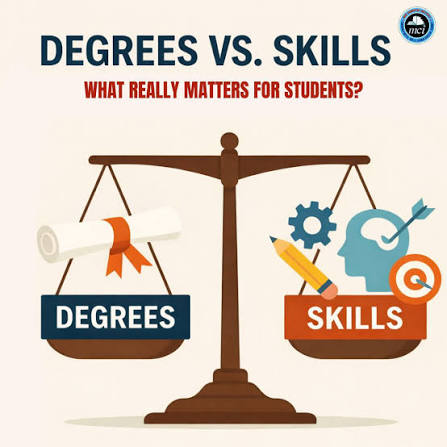

For generations, education has been celebrated as the golden key to success a clear, trusted path to a stable future.
Degrees were more than certificates. They were symbols of achievement, discipline, and promise. People chose careers driven by passion, purpose, and the desire to contribute meaningfully to society.
But today, that certainty is beginning to fade.
In a rapidly changing economy shaped by technology, unemployment, and shifting opportunities, a new question is taking center stage.
Is success still built in lecture halls or in the streets, workshops, and digital spaces where skills are sharpened daily?
Across Zambia and beyond, a growing number of young people are redefining success.
For many, entrepreneurship and practical skills popularly known as “hustling” are becoming faster, more reliable routes to financial independence.
The promise of a degree no longer feels as guaranteed as it once did.
Morris Kunda, a computer science graduate, understands this reality all too well.
“I expected to find a job as a network engineer,” he says. “Instead, I’m working as a logistics officer something completely different from what I studied.”
Like many graduates, Kunda carries both pride and frustration.
The journey he envisioned has not unfolded as planned.
“Right now, I’m not seeing the full value of my degree,” he admits. “But I still believe it adds something to your life. Even if the job doesn’t come immediately, it shapes you.”
His story reflects a growing truth: education is no longer a guarantee it is a foundation, one that sometimes requires patience, reinvention, and resilience.
On the other side of the debate stands Mary Chama, a hairdresser who chose skills over university and never looked back.
“I love being independent,” she says. “Why spend years studying for a job that may never come, when you can start earning now?”
For Chama, financial limitations pushed her toward learning a practical skill. But what began as necessity has turned into empowerment.
“Skills give you control,” she explains. “You don’t have to wait.you create your own opportunities.”
Still, she acknowledges that the conversation is not entirely one-sided.
“Honestly, combining both a degree and a skill is even better,” she adds. “That way, you’re prepared for anything.”
Felistus Phiri, a first-year natural sciences student, offers yet another perspective one rooted in belief in education’s long-term value.
“A degree gives you identity,” she says. “It gives you recognition in society. It opens doors.”
For her, higher education is not the final destination, but the beginning of a journey.
“You can build on it go further, specialize, and grow. It carries weight,” she explains.
Her view highlights an important reality: while the path may be longer, education still holds power especially when paired with determination and direction.
So where does the truth lie?
Perhaps not in choosing between degrees and skills but in understanding how the two can coexist.
Because the world has changed.
Employers are no longer looking only at qualifications they are looking for adaptability, creativity, and real-world ability.
At the same time, skills alone may not always provide the structure, credibility, or long-term growth that formal education can offer.
In this new economy, success is no longer linear.
It is flexible.
It is unpredictable.
It is personal.
And for many young people, it is being built through a blend of knowledge and action books and experience, theory and practice.
Because in a world that refuses to stand still, the real advantage belongs to those who can adapt,learn,unlearn,and rise again.
DEGREE OR SKILL?